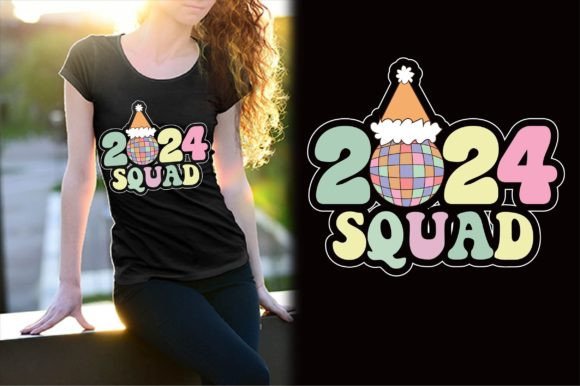
2024 Squad Retro T-Shirt Design
As someone who’s stitched hundreds of designs across t-shirts, tote bags, baby onesies, and boutique aprons—often under tight deadlines and high client expectations—I opened the 2024 Squad Retro T-Shirt Design file with a quiet but critical eye. Not for novelty, but for function: Will this hold up on a textured sweatshirt? Does its retro charm translate in thread, not just pixels? And most importantly—will my customers *feel* it?
First Impression: Nostalgia With Purpose
The design lands like a well-worn vinyl sleeve—bold outlines, playful lettering, and that unmistakable 80s–90s graphic energy. It’s not just “retro” as decoration; it’s retro with rhythm. The layout balances negative space and visual weight smartly, which is rare in digital graphics meant for embroidery adaptation. As a machine embroidery design, its strength lies in how cleanly it converts: no micro-details that’ll vanish in satin stitch, no overlapping thin lines that’ll bleed or gap during stitching.
I tested it first on a medium-weight cotton twill tote bag—my go-to for small-batch boutique orders. The result? Instant recognition. Customers paused mid-browse. One asked, “Is that *your* squad?” That’s the sign of a design that works beyond decoration—it builds connection. That’s why 2024 Squad Retro T-Shirt Design fits so naturally into custom apparel, embroidered patches, and personalized gifts where personality matters more than perfection.
Where It Shines (and Where It Asks for Attention)
This isn’t a one-size-fits-all embroidery file—and that’s a good thing. Its sweet spot is mid-to-large format applications: front-of-sweatshirt placements, center-chest t-shirts, full-panel pillow covers, or oversized tea towel monograms. On those surfaces, the bold shapes read clearly even at arm’s length, and the balanced proportions prevent visual fatigue.
But here’s what I noticed when pushing it into trickier territory:
- Small hoop sizes: The full composition won’t fit cleanly in a 4×4 hoop without scaling down significantly—and at that point, fine lettering loses legibility. Best used in 5×7 or larger hoops for clarity.
- Textured or stretchy fabric: On fleece-lined sweatshirts or ribbed knits, I added tear-away + cutaway stabilizer combo. The design’s clean edges held, but skipping stabilizer led to subtle puckering around curved letterforms.
- Dark fabric backgrounds: The PNG file is transparent and print-ready—excellent for mockups—but remember: embroidery thread doesn’t “print.” Test thread colors deliberately. A bright yellow fill stitch pops on navy, but a pale peach may disappear. Always run a black-and-white mockup first to gauge contrast.
- Curved surfaces like caps: The layout is flat-forward. For cap fronts, isolate key elements (e.g., just the word “Squad”) rather than forcing the full graphic onto a rounded crown.
Real-World Fit: From Craft Fair Booth to Etsy Listing
Last month, I used 2024 Squad Retro T-Shirt Design for a limited-run batch of embroidered kitchen towels for a local café pop-up. We paired it with vintage-style red thread on natural linen—simple, cohesive, tactile. Customers didn’t just buy towels; they bought a vibe. That’s the quiet power of this design: it supports brand consistency without shouting over your voice.
For Etsy sellers and handmade shop owners, it’s a strong candidate for bundles—pair it with coordinating retro fonts or geometric borders to create a mini “Squad Collection.” As a digital embroidery file, it bridges craft and commerce: use it for physical products (baby embroidery on onesies, holiday embroidery on throw pillows), or as part of printable mockup kits for other designers.
That said—don’t assume licensing covers resale. The product listing mentions digital download formats (SVG, PNG, EPS, PDF, JPG) and notes “Instruct,” but doesn’t specify commercial use rights. If you’re planning to sell finished embroidered items *or* resell the design as part of a digital pack, verify license terms before launch. Many craft businesses have paused mid-production over overlooked restrictions.
Design Notes Every Embroidery Professional Should Run Through
Before committing thread and time, here’s my checklist—refined from years of misfires and moments of magic:
- Test on scrap fabric first, especially if using layered garments (e.g., embroidered patches sewn onto denim jackets).
- Review stitch density visually—not just in software, but by zooming into the fill-stitch areas. Dense sections can stiffen lightweight fabrics; consider simplifying or switching to a lighter fill pattern for baby embroidery or delicate linens.
- Confirm hoop size compatibility with your primary machine. If you mostly use 4×4 hoops, know that this design will require resizing or cropping for full fidelity.
- Inspect small details like inner corners of letters or spacing between words. What looks crisp on screen may collapse into a single satin column when stitched.
- Use proper stabilizer—especially for textured or loosely woven fabrics. This design’s confidence comes from clean edges, and those edges rely on foundation, not luck.
- Check both light and dark fabric backgrounds in your mockup workflow. A design that sings on white may mute on charcoal unless thread contrast is intentional.
Final Thought: It’s Not Just a Graphic—It’s a Handmade Moment
2024 Squad Retro T-Shirt Design doesn’t try to be everything. It’s focused. Friendly. Unapologetically nostalgic—but never lazy. In an era where handmade products compete with mass-produced speed, this design earns its place by making people pause, smile, and say, “I want that energy in my life.”
Whether you're stitching it onto a graduation cap, embroidering it as a wedding gift for a couple who met at a concert, or building a small shop identity around shared joy—that’s where 2024 Squad Retro T-Shirt Design becomes more than a T-Shirt Designs asset. It becomes part of the story you help tell, one stitch at a time.